Woodworking as a metaphor for revealing what lies within
The Last Thing He Told MeWoodworking is both Hannah Hall’s inherited craft and a way of reading the world: making something beautiful requires not only shaping material, but also attending to what is already inside it. Her grandfather’s work teaches her to approach difficulty through patience, close observation, and continued effort. Years later, as she tries to understand Owen Michaels’s disappearance and the pull of Austin, that practical knowledge becomes a method for uncovering what lies beneath appearances—and for recognizing what she has already decided to do.
Craft and Inheritance
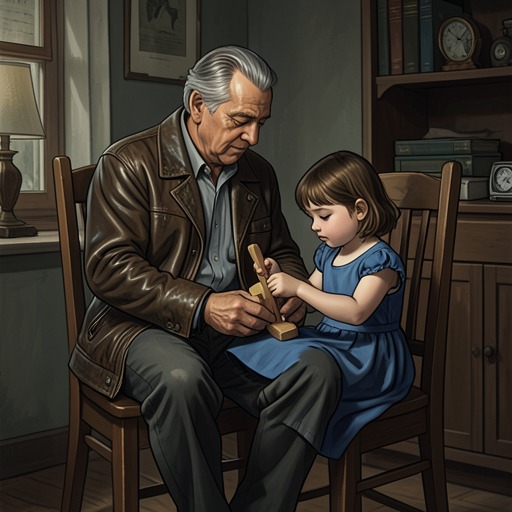
Hannah describes her work as woodturning: sculpting wood rather than clay. The distinction matters because the work begins with a substantial piece of material that must be turned on a lathe, not with a formless substance that can simply be made to match an idea. Her craft grows into furniture-making, but its first model is her grandfather, an excellent woodturner whose work has been central to her life for as long as she can remember.
That inheritance is personal as well as technical. Hannah’s grandfather largely raised her while her parents were absent from her childhood. Her father traveled for work, and her mother, Carole, left Hannah with him full-time after pursuing her father and then leaving again. Against that history of departures, the grandfather’s steadiness is conveyed through repeated, ordinary care: he makes dinner, waits until she has finished eating before announcing that it is time for stories, and lets her watch him work. The workshop is therefore not merely where Hannah first encounters a profession. It is one of the places where she experiences sustained attention and learns what it looks like to remain present.
Hannah watches her grandfather begin with what seems an impossibly enormous block of wood and work it on the lathe until it becomes something “magical.” The word describes the transformation as it appears to a child, but the process also depends on labor and judgment. A piece does not become beautiful by wish alone; it has to be worked, and the work may have to change direction.
Starting Again, Not Giving Up
When a piece is not turning out as hoped, Hannah’s grandfather does not treat the first attempt as the only possible route. He throws up his hands and says, “Well, we’ve got to do this different, don’t we?” Then he finds another way into the work. The gesture makes revision visible: a setback can require a new approach without making the underlying effort worthless.
Hannah considers whether watching this might have given her hope that her grandfather would help her start over in her own life. She presents that as a possibility, not a settled psychological explanation. What she says she took comfort in was almost the reverse. Some things, she learned, do not become fluid simply because they are difficult. They must be approached from different angles, but not abandoned. The distinction between changing a method and giving up on the work is central to the metaphor: persistence need not mean repeating the same attempt, and adaptation need not mean surrendering what matters.
That lesson also gives the craft an ethical dimension. The work required is whatever the task demands, wherever it leads. Hannah’s grandfather’s practice offers no promise that every piece will turn out as intended, nor that effort will make a hard situation easy. Instead, it gives her a way to remain with a problem long enough to see it more clearly and to find another means of proceeding.
Peeling Back to See What Is There
When Hannah’s thoughts turn to Austin, she understands that she cannot simply tell someone else why the place matters to her. The U.S. marshal who came to the house is based there; Bailey may remember being there; and Owen reacted strangely to the idea of going there on two separate occasions. Hannah says to herself that Austin is all she has. The clues are incomplete, but their recurrence gives her a reason to look beneath her uncertainty rather than dismiss it.
In that moment, she imagines what her grandfather would do: sit with her and help her work through the facts until she understood what she needed to do. She recalls his first lesson—that woodturning is not only about shaping a block into the desired form. It also involves “a peeling back,” seeing what is inside the wood and what the wood was before. In her account, this is the first step toward making something beautiful, and the first step toward making something out of nothing.
The metaphor holds two kinds of attention together. Shaping concerns what might be made; peeling back concerns what the material already is. The second does not erase the first: Hannah’s grandfather’s work requires both an aim and an understanding of the wood being worked. Applied to the mystery around Owen, this means that Hannah cannot simply impose a reassuring explanation on the evidence. She has to consider the history and concealed facts that may already be present beneath what she can see.
The Lesson Returns as a Decision
Hannah extends the comparison from her grandfather to Owen. She imagines that Owen would understand the need to look beneath appearances and that he would ask, “What do you have to lose?” The recollection does not resolve the unanswered questions about him. Instead, it connects the intimacy of their understanding to Hannah’s own recognition that she has already chosen a direction.
The phrase “Protect her” follows that recognition. Its brevity contrasts with the careful process that precedes it: Hannah has sorted through repeated clues, recalled the people who would help her think clearly, and arrived at an obligation that gives those clues urgency. The woodworking metaphor therefore moves beyond an image of personal resilience. It describes a way of discovering what is already there, and a way of acting once that discovery makes the next piece of work unavoidable.